Honda And Tohoku University Launch New Research Centre For Future Mobility

Honda is strengthening its push into next-generation mobility research through a new collaboration with Japan’s Tohoku University, bringing together academic research and Honda’s real-world engineering expertise.
Honda R&D Co., Ltd., the research and development arm of Honda Motor Co., Ltd., and Tohoku University have established the Honda R&D x Tohoku University Innovative Mobility System Co-creation Research Center.

The new research centre is based within Tohoku University’s Institute of Fluid Science (IFS) and will operate for three years, from 1 September, 2026 to 31 August, 2029.
Rather than focus solely on developing a particular vehicle or technology, the centre is intended to act as a research hub for identifying advanced technologies that could eventually be translated into practical mobility applications.
From University Research To Real-World Mobility
Honda said the collaboration will combine Tohoku University’s academic expertise with the technical knowledge Honda has accumulated through its mobility businesses.
The two organisations will explore emerging areas of deep technology and other advanced research themes before identifying areas where joint research could have practical applications.
Research strategies will then be developed around those areas, followed by joint research aimed at accelerating the transition from academic findings to technologies that can be applied in the real world.
This approach could prove important as the automotive industry expands beyond conventional engine and vehicle development into areas such as electrification, advanced materials, energy technologies, automation and intelligent mobility systems.
The partnership also gives Honda access to expertise from different parts of Tohoku University rather than limiting the research to a single academic discipline.
Wider Research Network
The centre will collaborate with faculties, schools and other units across Tohoku University to identify promising research areas and emerging technologies.
Among the participating researchers are specialists from the Tohoku Center of Excellence for Microscopy, the Research Center for Green X-Tech, and Tohoku University’s Institute of Fluid Science.
Honda R&D will be represented by Fellow Toshiro Kiura, who will serve as Director of Research Operations, while Chief Engineer Shigeru Omura will act as the participating company liaison.
Tohoku University Associate Executive Vice President and Institute of Fluid Science Professor Kaoru Maruta will serve as Operation Support Manager.
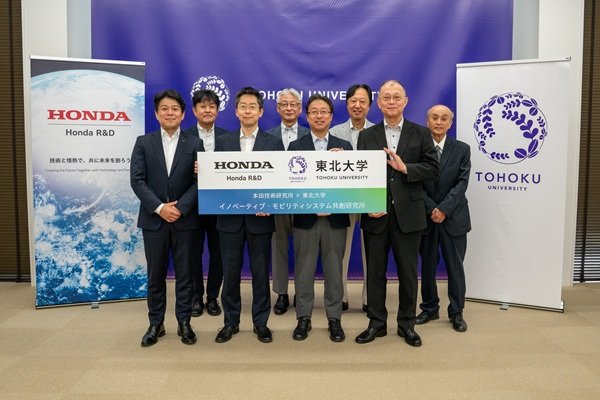
Specially Appointed Professor Terauchi; Director Toyama (Industry-Academia Collaboration); Vice Director Oda; Professor Maruta; and Research Fellow Nakano of Tohoku University.
Importance For Honda
For Honda, the significance of the partnership goes beyond individual research projects.
The company is effectively creating a pipeline connecting university research, Honda’s engineering expertise and eventual commercial applications. This could allow technologies developed in academic environments to be evaluated earlier for their usefulness in mobility products and services.
Honda and Tohoku University also intend to use the centre to develop talent and share knowledge, creating what they describe as a cycle between research, people and technological expertise.
This could be valuable as mobility companies compete not only on vehicle hardware, but also on the technologies and scientific capabilities underpinning the next generation of transportation.
Three-Year Timeline
The new centre is located within Tohoku University’s Institute of Fluid Science and will operate until the end of August 2029.
It is part of Tohoku University’s broader Co-creation Research Center programme, which was established in 2021 to encourage interdisciplinary collaboration between the university and external organisations.
As of the end of August 2026, Tohoku University shared that it has more than 50 such co-creation research centres.
For Honda, the latest partnership provides another route to explore technologies that may not yet have an obvious automotive application today, but could eventually contribute to how future mobility systems are designed and operated.
CarTok Editor’s Note
This partnership is not the creation of another research centre but the bridge between fundamental science and commercial mobility.
The automotive industry is moving into territory where breakthroughs might come from fields far removed from traditional vehicle engineering. By putting Honda engineers alongside researchers from different disciplines, this collaboration gives the automaker a way to identify promising technologies before they become mainstream.
The three-year timeframe also suggests this is about building a technology pipeline. The measure of success will ultimately be whether research from the centre can make the transition from laboratory work to something tangible that improves mobility products and services for consumers.